
An EV charger — more precisely called electric vehicle supply equipment, or EVSE — is the equipment that delivers electricity from the grid to your car’s battery. [1] It is not one product. The three practical categories are Level 1 (120-volt), Level 2 (240-volt) and DC fast charging, and they differ in speed, hardware and where you find them. [2]
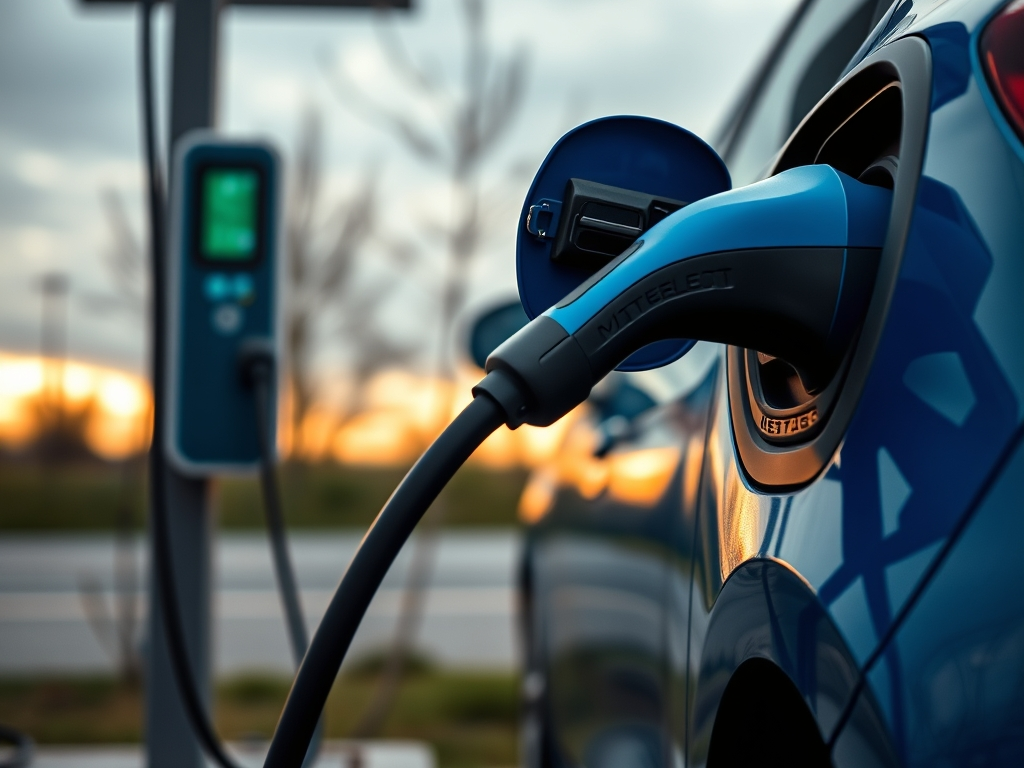
How does an EV charger work?
The key fact is that an EV battery can only be charged with direct current, while most electricity from the grid arrives as alternating current. [1] That mismatch explains the whole design of charging equipment.
Most electric vehicles carry a built-in AC-to-DC converter usually called the onboard charger. At an AC charging station, grid power is fed to that onboard charger, which converts it into DC to recharge the battery. [1] A DC fast charger does the conversion differently: the converter is built into the station itself, which avoids the size, weight and cost limits of putting it in the car, and DC power goes straight to the vehicle, bypassing the onboard converter. [1] The EPA describes the same split, noting that DC fast chargers supply high levels of electricity more directly to the battery and skip the vehicle equipment that normally converts AC to DC. [2]
So for Level 1 and Level 2 charging, the box on your wall or the cord set in your trunk is mostly delivering AC power safely; the actual charger is in the car. For DC fast charging, the big equipment at the station is doing the charging work.
One behavior to know: DC fast charging is fastest when the battery is closer to empty and slows as it approaches full, so it usually saves time to fast-charge to around 80 percent and move on. [2]
What are Level 1, Level 2 and DC fast chargers?
Level 1 uses the same 120-volt outlet you use for a phone charger or a toaster. The cord set often comes with the vehicle, so there may be nothing to install. [2] It adds roughly 5 miles of range per hour of charging. [2] Charging from empty can take 40 to 50 hours. [3] That sounds slow, but U.S. car owners drive about 31 miles a day on average, and many people with commutes under 40 miles a day find overnight Level 1 charging sufficient. [2][3]
Level 2 uses a 240-volt outlet of the kind an electric oven or clothes dryer uses, and it requires additional equipment rather than just the cord that came with the car. [2] It adds about 25 miles of range per hour [2] and can charge from empty in roughly four to ten hours. [3] If you don’t already have a 240-volt outlet where you park, a qualified electrician can install one and the charger, and can determine whether your home has enough capacity or needs an upgraded electrical panel. [2]
DC fast charging is the public-network option, found mainly along highways and in cities for long trips and quick top-ups. [2] It can add roughly 100 to 300+ miles in 30 minutes [2] and charge from empty in as little as 20 minutes. [3] Early public fast chargers usually delivered about 50 kW, while those installed now are typically at least three times that, with some reaching 350 kW [3]. Not every car can accept those rates — an EV that can only take 50 kW won’t benefit from a 350 kW station. [3] Public fast charging is also more expensive to use than charging at home or at work when you have the time. [2][3]
Which plugs and standards will you meet in the US?
Apart from Teslas, every EV sold in the U.S. uses a J1772 connector, or J-plug, for Level 1 and Level 2 charging [3]. For DC fast charging, U.S. EVs other than Teslas use either CCS, the most common, or CHAdeMO, depending on the brand. [3] Teslas use the same proprietary plug at every level, including at Superchargers, and come standard with a J1772 adapter. [3]
A wider set of standards exists — SAE J1772, IEC 62196 Type 1 and Type 2, CCS, CHAdeMO, China’s GB/T and Tesla’s North American Charging Standard (NACS) — each covering connectors, power levels and safety rules, and competition among them means many DC stations offer more than one connector [1]. In North America the cable is permanently attached to the charging equipment rather than using a socket outlet and separate plug. [1]
Check your car’s inlet before buying anything. Not every public station fits every car. [3]
What is an untethered EV charger, and what is a granny charger?
“Untethered” describes charging equipment whose cable is not permanently fixed to the unit — you supply or connect the cable yourself. That is a less common setup in North America, where the cable is normally permanently attached to the equipment. [1]
“Granny charger” is informal shorthand for the slowest option: the cord set that plugs into an ordinary household outlet, which is exactly the Level 1 case the EPA describes, where the charge cable that often comes with the vehicle goes straight into a 120-volt outlet. [2]
What to check before you choose a charger
- Your daily mileage. If you drive well under 40 miles a day, Level 1 may cover it overnight. [2]
- Your parking and wiring. Level 2 needs 240-volt equipment and, in many homes, an electrician’s assessment of panel capacity. [2]
- Battery habits. Most manufacturers suggest keeping charge in the 20 to 80 percent range to extend battery life, which also means you rarely charge from empty to full. [3]
- Incentives. Some incentives could cover the cost of Level 2 equipment, so it is worth checking what applies where you live. [3]
- Renting or no garage access. Public Level 2 charging is common at workplaces and commercial parking lots, and DC fast charging suits drivers who cannot charge at home. [3]
EV charging brands compared
| Brand | What they offer | Worth knowing |
|---|---|---|
| Emporia | Presents itself around smart home energy management, with the site banner “Smart Home Energy Management Made Easy” [4] | Confirm the current charger lineup and whether the brand sells and ships in your region before ordering [4] |
| Lenz Charging | EV charging products and accessories available in the US, including a NACS Supercharger to CCS1 adapter and a UL-compliant EV charging ready receptacle [5] | Fields a U.S.-based customer support team and was the official charging partner of the 2026 San Diego International Auto Show [5] |
| Lectron | Level 1 chargers rated 120V, 12–15A, up to 6 miles/hr and Level 2 chargers rated 240V, 40–48A, up to 46 miles/hr, plus NEXUS and V-BOX charging stations, NEMA 5-15 and 14-50 plugs, and NACS and J1772 adapters, sold in the US [6] | The brand lists a NACS-to-CCS adapter rated at 500A and 1,000V and a NACS-to-J1772 adapter rated at 80A and 240V, and describes its CCS-to-NACS adapter as UL 2252 certified [6] |
Which option fits whom
If your interest is the wider picture — how charging fits with the rest of your home’s electricity use — Emporia’s stated focus on smart home energy management is the closest match of the three, and you should verify current products and shipping for your area on its site. [4]
If your problem is access rather than speed, Lenz Charging’s catalog centers on adapters and charging accessories, including a NACS Supercharger to CCS1 adapter for drivers whose cars are not native to that network. [5]
If you want a broad menu of hardware with published electrical specs — Level 1 and Level 2 chargers, charging stations, NEMA plug types and both NACS and J1772 adapters — Lectron lays those out by category. [6] Match any adapter’s amperage and voltage rating to both your car and the station you plan to use. [6]
Whatever you pick, the fundamentals don’t change: the connector has to fit your car, the circuit has to be safe for the load, and the charging speed has to match how far you actually drive. Confirm current product details, certifications and regional availability on each brand’s site before you buy.
Sources
- Charging station (Wikipedia) — Wikipedia
- Title: Plug-in Electric Vehicle Charging: The Basics | US EPA — epa.gov
- Title: Electric Vehicle Charging Explained — nrdc.org
- Emporia official site — emporiaenergy.com
- Lenz Charging official site — lenzcharging.com
- Lectron official site — ev-lectron.com
How we put this together: we compared these options using each brand's published product and policy pages and the references listed above. We haven't tested the products ourselves, and details such as prices and policies can change, so check the brand's site before you buy.
You may also find What Is a Portable Power Station and How Does It Work? useful.