
The best EV charger for a Tesla is usually a Level 2 unit with a Tesla-style NACS connector, either hardwired or plugged into a 240-volt outlet, sized to the miles you actually drive. Tesla’s connector is the North American Charging Standard, and third-party brands sell NACS-compatible home chargers, such as a 48A hardwired model from Lectron. [1][2]
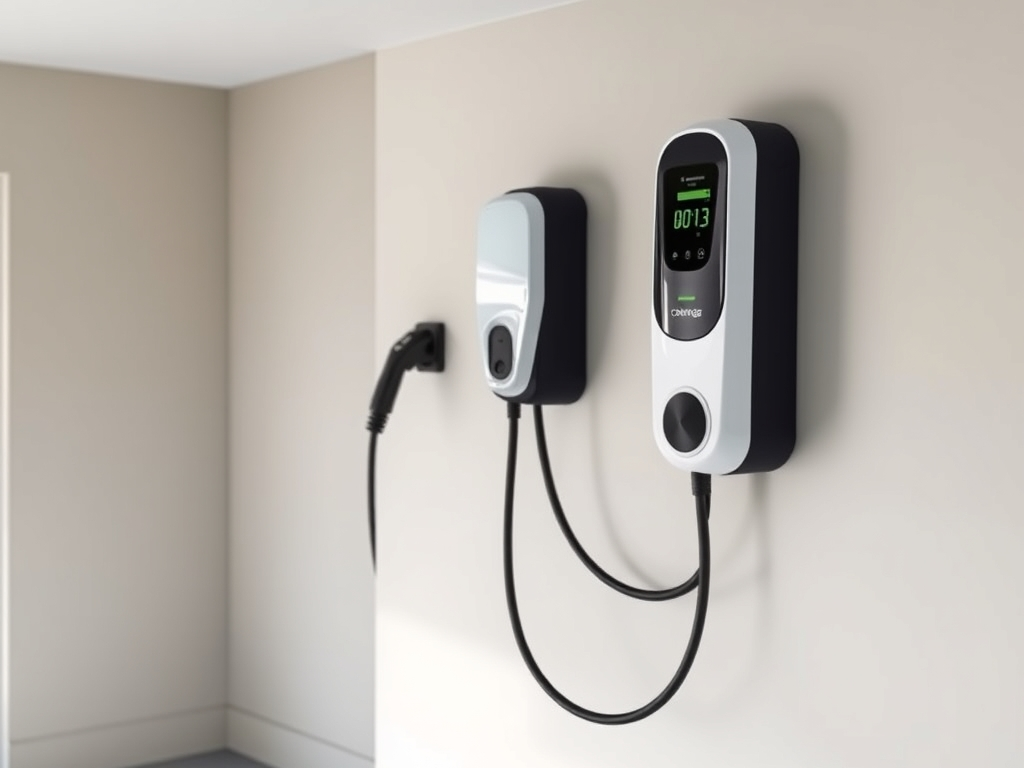
Start with the connector, not the logo
Tesla’s connector is the North American Charging Standard (NACS), one of several regional standards alongside SAE J1772, IEC 62196, CCS, CHAdeMO and China’s GB/T. [1] Those standards set the connector, the power levels and the safety rules, and they differ by region. [1] So the first question for any home charger is whether it terminates in a NACS plug.
Other brands list NACS hardware openly. Lectron sells a NEXUS L2 NACS charger rated 48A at 240V for hardwired installation, and a portable NACS unit adjustable from 8A to 40A that runs on 120V or 240V. [2] In North America the cable is permanently attached to the charging equipment rather than using a socket outlet and plug, which is worth knowing when you compare product photos. [1]
AC or DC, and why a home charger is AC
A home charger supplies alternating current. The battery can only be charged with direct current, so the car’s built-in onboard charger converts grid AC into DC. [1] DC fast chargers build a much larger AC-to-DC converter into the station itself and supply DC power straight to the vehicle, bypassing the onboard charger, which is what allows higher-power charging. [1] That is the practical dividing line: a home charger is an AC device, and the public fast-charging network is a separate system. In January 2023, S&P Global Mobility put the U.S. count at approximately 126,500 Level 2 stations and 20,400 DC fast-charging stations, along with roughly 16,800 Tesla Superchargers and destination chargers. [1]
Level 1, Level 2, and how much speed you need
Level 1 charging uses a standard household outlet. Lectron rates its Level 1 chargers at 120V, 12–15A and up to 6 miles of range per hour; its Level 2 chargers run at 240V, 40–48A and up to 46 miles per hour. [2] Those are the brand’s own figures, and they show the size of the gap: a 240-volt circuit is what turns home charging from an overnight trickle into something that keeps up with daily driving.
Two installation paths sit behind those numbers. Lectron organizes its plugs around NEMA 5-15 for Level 1 and NEMA 14-50 for Level 2, and lists both hardwired chargers and plug-in models on that outlet. [2] Hardwiring avoids the plug and outlet entirely; a plug-in unit is easier to move or replace. Either way, have an electrician confirm your panel has spare capacity before you buy, since the amperage on the box is not the amperage your service can necessarily deliver.
Placement matters less than people expect. Charging equipment can be installed wherever the electrical grid reaches, including private garages, carports and even roadside parking spots. [1] If you park outdoors, plan for a unit rated for that location and for cable management.
Do you need a Tesla-branded charger, or will another NACS unit do?
A charger is electric vehicle supply equipment: it delivers power from your premises wiring to the car, and the car’s onboard charger does the conversion. [1] Nothing in that chain requires the charger to share a brand with the vehicle, provided the connector and the electrical ratings match. What you may give up by going third-party is tight integration with the car’s own app and route planning; what you may gain is a form factor or feature set you prefer. Check the connector type, the amperage, the certifications listed and the warranty terms on the product page.
For a Model Y or any other Tesla, the sizing calculation is the same: miles driven per day, hours the car sits parked, and the capacity your panel can spare. A car that sits for ten hours overnight needs far less amperage than one that has to charge in a two-hour window.
Adapters a Tesla owner might actually need
Adapters solve the opposite problem from a home charger: they let a car use equipment it wasn’t built for. Lectron lists a CCS to NACS adapter rated 500A and 1,000V and marked UL 2252 certified, which lets a Tesla use CCS charging equipment, plus a NACS to J1772 adapter rated 80A at 240V for J1772 chargers. [2] These are travel accessories, not substitutes for a home unit.
Lenz Charging frames its site around chargers, adapters and accessories and headlines a NACS Supercharger to CCS1 adapter, and it points to a U.S.-based customer support team. [3] Note the direction: that headline adapter is aimed at a CCS-equipped car using Tesla’s network, which is not what a Tesla needs at home. Lenz also lists a UL compliant EV charging ready receptacle among its products. [3]
The options side by side
| Brand | What they offer | Worth knowing |
|---|---|---|
| Emporia | Its homepage titles the company as a smart home energy management brand. [4] | Confirm which charger models and connectors are currently listed, and check availability in your region before planning an install around it. [4] |
| Lenz Charging | Chargers, adapters and accessories, including a NACS Supercharger to CCS1 adapter and a UL compliant EV charging ready receptacle, with a U.S.-based support team behind the site. [3] | Its headline adapter faces CCS cars using Tesla’s network, so confirm that a home NACS charger is part of the current lineup, and check whether it ships to you before ordering. [3] |
| Lectron | Level 1 and Level 2 chargers plus Tesla/NACS and J1772/CCS adapters; the NEXUS L2 NACS charger is 48A at 240V hardwired, and a portable L1/L2 NACS unit runs 8–40A on 120V or 240V. [2] | Lectron rates Level 2 at up to 46 miles per hour and Level 1 at up to 6 miles per hour, and lists its CCS to NACS adapter as UL 2252 certified. [2] |
Which option fits whom
If you want one brand for the wall unit and the road adapters, Lectron is the most complete fit of the three: its catalog pairs a 48A hardwired NACS charger and a portable NACS unit with CCS and J1772 adapters, all described on the same site. [2] That matters if you would rather keep one set of accessories and one support channel.
If you already have a Tesla and mostly charge at home, focus the decision on connector and amperage rather than on extras. A hardwired 48A NACS unit and a portable 8–40A unit serve different households: the first for a dedicated parking spot, the second for renters or anyone who may move. [2]
If you want charging tied into a wider energy picture — solar, time-of-use rates, monitoring — Emporia presents itself as a smart home energy management company, so check what its charger range and app actually cover before you commit. [4] Verify availability in your region and confirm the connector type on the specific model.
If you travel between charging networks, budget for adapters separately from the charger. A CCS to NACS adapter opens up CCS equipment to a Tesla, while a NACS to J1772 adapter covers the older connector — both are listed as separate products, and both only help away from home. [2]
If your panel is tight, look at plug-in and lower-amperage options first. Lectron lists Level 2 chargers on a NEMA 14-50 outlet as well as hardwired versions, which gives an electrician more than one way to fit the load. [2]
Before ordering, confirm the current connector options, amperage settings, certification listings, whether the brand ships to your address, and the return terms on the brand’s own site, since product lines and availability change.
Sources
- Charging station (Wikipedia) — Wikipedia
- Lectron official site — ev-lectron.com
- Lenz Charging official site — lenzcharging.com
- Emporia official site — emporiaenergy.com
How we put this together: we compared these options using each brand's published product and policy pages and the references listed above. We haven't tested the products ourselves, and details such as prices and policies can change, so check the brand's site before you buy.