
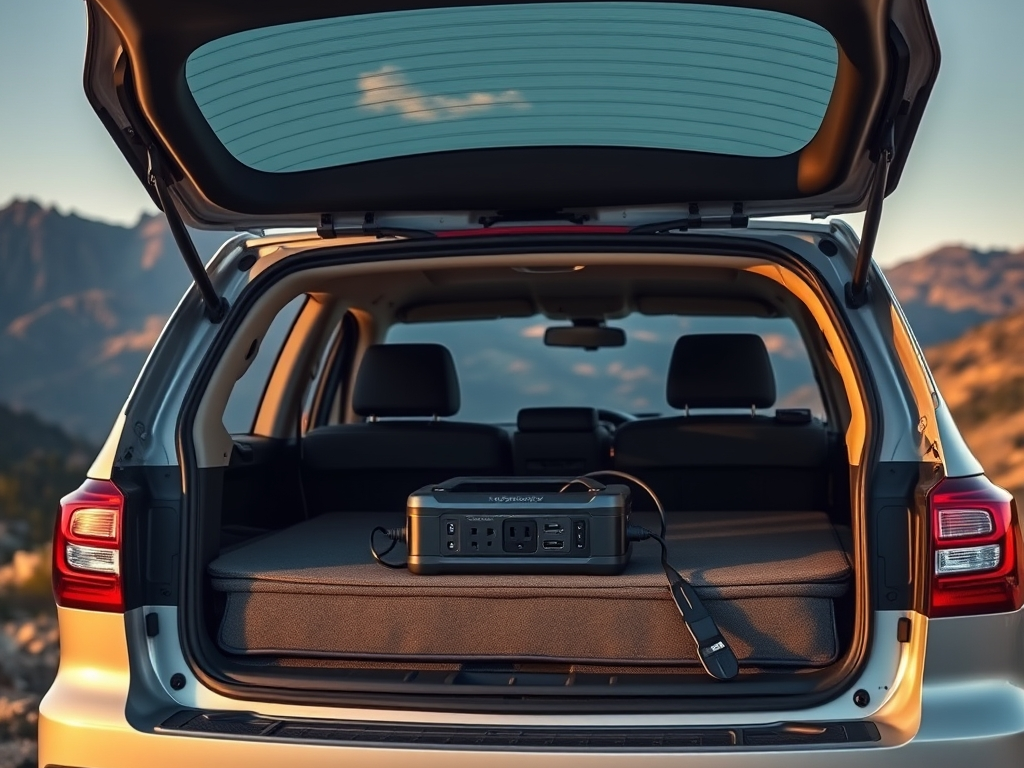
The short answer to what is a portable power station is: a rechargeable battery in a carrying case, with standard AC outlets, USB ports and usually a 12V output, sized to be moved rather than wired into a house. You charge it from a wall outlet, a car or solar panels, then plug appliances into it during an outage or away from an outlet. It burns no fuel and makes no exhaust, and it holds a fixed amount of energy that you have to plan around.
What does a portable power station do?
It takes stored DC power from its battery, converts it to household AC through a built-in inverter, and feeds whatever you plug in. Capacity is listed in watt-hours (how much energy it holds) and output in watts (how much it can deliver at once). The range on the market is wide: Jackery lists units from a 288Wh model with a LiFePO4 battery up to a 5040Wh unit rated at 7200W with 120V/240V output [1]. EcoFlow lists a 1kWh DELTA 3 Classic with 1800W output [2], and Anker SOLIX lists a 5kWh S5000 [3].
Most units give you 120V household outlets, USB-A and USB-C ports, and a 12V car-style socket. Bigger units can supply 240V for loads such as a well pump, a window air conditioner or a dryer circuit: EcoFlow says its DELTA Pro 3 offers 120V and 240V outputs, up to 4000W, from one unit [2], while Anker SOLIX bills its F3800 Plus as 240V plug-and-play power for home AC and the fridge [3].
Some sellers use “mobile power station” for exactly the same product. If you see that phrase, look at the same two numbers — watt-hours and watts.
How does a portable power station work?
Three parts do the work: the battery, the inverter, and a charge controller that manages power coming in from the wall, a car socket or solar panels. The battery chemistry matters more than most spec sheets suggest. Lithium iron phosphate (LiFePO4, or LFP) is common in these units because of its low cost, high safety, low toxicity and long cycle life, and it is already used in backup power applications [4]. LFP also lasts a long time: cycle life runs from about 2,500 to more than 9,000 cycles depending on conditions, and under most conditions it supports more than 3,000 cycles while nickel manganese cobalt (NMC) cells support roughly 1,000 to 2,300 [4].
The trade-off is weight. LFP batteries have lower specific energy than NMC and other common lithium-ion types, so an LFP station is heavier for the same capacity [4]. A unit you can lift into a car by yourself and a unit that can run a fridge for a day are often different products.
Charging is where solar comes in. Many stations accept panels directly, which is why brands sell “solar generator” bundles — a station plus folding panels — as a package. EcoFlow’s product history runs from the original RIVER mobile power station through the DELTA and RIVER 2 series, so the category has been around long enough that naming has settled into station, solar generator and home backup [5].
What is a portable power station used for?
Three broad uses, and they need different sizes.
- Outage backup for essentials. Lights, phones, a router, a fan, a CPAP machine, a fridge cycling on and off. Anker SOLIX rates its 2kWh S2000 at up to 35 hours of fridge backup [3], which shows how quickly capacity gets used by a compressor appliance.
- Outdoors and mobile use. Camping, RV trips, tailgates, job sites without power. Jackery organizes its catalog around outdoor solutions, home backup, camping, RV adventures and off-grid living [1].
- Working away from an outlet. Laptops, cameras, tools and small appliances, where a modest station is enough.
There is a second category that gets confused with portable stations: whole-home battery systems. Anker SOLIX’s E10 monitors severe weather, charges itself from solar and the grid, and balances power across up to 12 circuits during an outage [3]. That is installed equipment, not something you carry to a campsite. Anker SOLIX also notes that its portable power stations can back up a home through a manually activated transfer switch [3].
Is a portable power station worth it?
It is worth it when you have a recurring job for it — outages that happen often enough to plan for, regular camping or RV trips, or a device like a CPAP that has to keep running. It is hard to justify if you lose power once every few years and would only use it to charge phones.
Four questions settle it for most people:
- What has to keep running, and for how long? Add up the watt-hours of the appliances you genuinely need, not everything in the house.
- Can you recharge it during a long outage? A station is a fixed tank. If the grid is down for days, solar input or a car charger is what refills it.
- Where will it live? LFP is heavier per watt-hour than other lithium-ion chemistries [4], so a big unit may stay in one spot rather than travel.
- How does it fail? Batteries are safe when they are certified and not damaged, but recalls happen. EcoFlow recalled 25,000 DELTA Max 2000 power stations in 2025 over fire risk [5]. Before buying any brand, check current recall notices and look for safety certification: EcoFlow describes the DELTA Pro Ultra as certified to both UL1973 and UL9540 [2], and Anker SOLIX lists UL9540 and UL9540A certification for the S5000 [3].
How to size one without overbuying
Work backwards from the appliances. Note the running watts of each one you care about, check whether it has a higher startup surge (motors and compressors do), and multiply watts by the hours you need. Compare the total to the station’s usable watt-hours, then add a margin for conversion losses and for the fact that you rarely run appliances exactly as planned. If the number you land on is far below what the smallest models offer, buy smaller — a heavy unit that stays in the garage helps no one.
Options compared
| Brand | What they offer | Worth knowing |
|---|---|---|
| Jackery | Solar generators and portable power stations from a 288Wh LiFePO4 model up to a 5040Wh unit rated 7200W with 120V/240V output, plus a home backup lineup and refurbished units [1] | The site states 30-day returns and up to 5 years of free warranty, and publishes a “What is Portable Power Station” guide [1] |
| EcoFlow | RIVER and DELTA series plus whole-home backup; the DELTA Pro 3 is expandable from 4kWh to 48kWh with 4kW output and both 120V and 240V [2] | The US site says free shipping on all orders but no shipment to outlying areas including Puerto Rico, Hawaii and Alaska, and returns are accepted within 30 days of receipt for US orders only [2][6] |
| Anker SOLIX | The 5kWh S5000 portable station with UL9540 and UL9540A certification, the 2kWh S2000, the 240V F3800 Plus, and the E10 whole-home system with up to 12 circuits [3] | Anker SOLIX says it is available in 146 countries and offers a backup time calculator to match storage to your outage essentials [3]; check whether it ships to your US address |
EcoFlow is a Chinese company established in 2017 that develops portable power stations, smart devices and home energy systems [5].
Which option fits whom
- You want one box for camping and light outage backup: a mid-size station in the 1kWh class, such as the EcoFlow DELTA 3 Classic at 1800W output [2] or a Jackery unit in its smaller tiers [1].
- You want to keep a fridge and a few circuits alive at home: look at the 2kWh-and-up class. Anker SOLIX rates the 2kWh S2000 at up to 35 hours of fridge backup [3], and Jackery’s larger HomePower models step up from there [1].
- You need 240V for a well pump, AC or dryer: EcoFlow’s DELTA Pro 3 delivers 240V from a single unit [2], and Anker SOLIX positions the F3800 Plus for 240V home AC and fridge [3].
- You want installed whole-home backup rather than something portable: Anker SOLIX’s E10 with up to 12 circuits is aimed at that job [3], and EcoFlow sells whole-home battery systems alongside its stations [2].
- You care most about certification paperwork: EcoFlow’s DELTA Pro Ultra is described as certified to both UL1973 and UL9540 [2], and the Anker SOLIX S5000 to UL9540 and UL9540A [3].
Whatever you shortlist, confirm the current capacity, output, certifications and return terms on the brand’s own site before ordering, since specifications and policies change between model years.
Sources
- Jackery official site — ca.jackery.com
- EcoFlow official site — ecoflow.com
- Anker SOLIX official site — ankersolix.com
- Lithium iron phosphate battery (Wikipedia) — Wikipedia
- EcoFlow (Wikipedia) — Wikipedia
- EcoFlow: Return & Refund Policy — us.ecoflow.com
How we put this together: we compared these options using each brand's published product and policy pages and the references listed above. We haven't tested the products ourselves, and details such as prices and policies can change, so check the brand's site before you buy.