
A portable solar panel that has stopped charging is often not broken. The most common reason is too little direct sunlight reaching the cells — shade, a flat angle, haze, dust or a low winter sun. Next come connection problems: the wrong cable, a loose connector, or a panel voltage the power station will not accept. Work through sunlight, then cabling, then compatibility before you decide why your portable solar panel is not working and needs replacing.
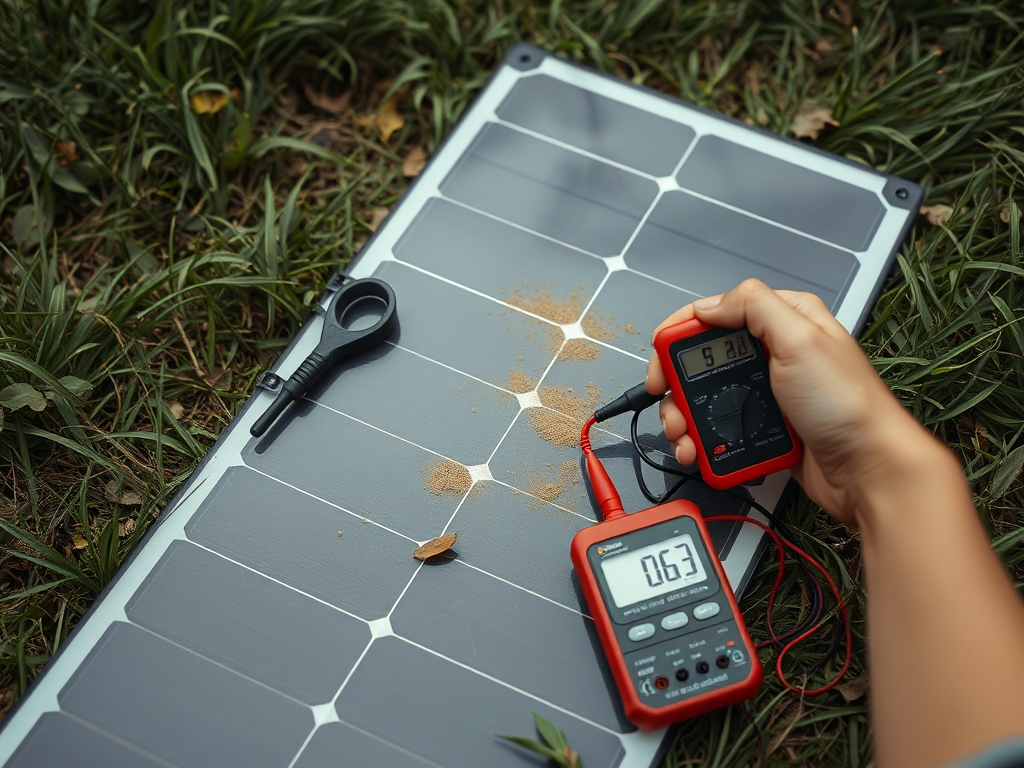
Check the sunlight and the panel’s position first
The U.S. Department of Energy lists season, time of day, clouds, dust, haze, and obstructions such as shadows, rain, snow and dirt as things that change how much power a photovoltaic system produces. [1] Solar panels depend on the availability and intensity of sunlight and need cleaning, as a general matter of how the technology works. [2]
What to check, in order:
- Shade on any part of the panel. Move it a few feet and watch whether the charging indicator changes. Shadows are one of the listed causes of reduced PV output. [1]
- Angle and direction. A panel lying flat collects much less than one tilted toward the sun. Reposition it and compare.
- Time of day and season. Peak use often falls in the late afternoon and evening, when solar generation is already falling off. [1]
- A dirty or snow-covered surface. Dust, dirt, rain residue and snow all belong on the DOE’s list of output-affecting conditions. [1] Wipe the panel with a soft cloth and recheck.
- Where you are charging. Panels are usually arranged in arrays or systems, and the electricity they make is direct current that can run devices or be stored in a battery. [2] If you are charging a power station indoors through a window, expect far less than outdoors.
If moving the panel into clean, unshaded midday sun changes nothing at all, the sun is probably not your problem.
Rule out the cable, connectors and charge path
A surprising share of “dead panel” cases are a cable problem, not a panel problem. The USDA Forest Service’s field-charging guide cautions that solar-panel power needs overvoltage protection, and that extra gear should be presumed necessary unless a charge controller is expressly marketed for wiring straight to a panel. [3]
The same guidance draws a line between converters, which simply change power from one voltage to another, and chargers, which include monitoring and control circuits that check charging progress and adjust applied voltage and current. [3] That matters because the box between your panel and your battery is doing real work.
Checks worth doing:
- Reseat every connector at both ends — panel to cable, cable to power station. Push until it clicks.
- Look inside the connectors for bent pins, corrosion or grit.
- Try a different, known-good solar cable if you have one.
- Try charging the power station from a wall outlet. If that works, the station’s input is fine and the fault sits on the solar side.
- Check whether the panel needs a charge controller between it and the battery, per the USDA caution above. [3]
Match the panel to the power station’s input
Panel and power station have to agree on voltage and connector type. The USDA guidance notes that different battery chemistries require different charging procedures, and one charger cannot be shared across chemistries at the same voltage unless it is programmable and designed for them. [3] You do not need to memorize chemistry charts — you need to confirm that the panel’s output range falls inside what your station’s solar input accepts.
Two practical consequences:
- Too much voltage is a real risk, not a theoretical one. The USDA guidance says protection against excessive voltage is required when a solar panel supplies the energy. [3]
- A panel can be fine and still not charge a given station if the station’s input window or connector standard does not match. Read the input specifications on the station and the output specifications on the panel before blaming the hardware.
Why the panel never reaches its rated wattage
Rated wattage is a headline number; delivered wattage follows conditions. The DOE attributes variation in solar output to season, time of day, clouds, dust, haze, shadows, rain, snow and dirt. [1] Energy storage exists precisely because solar energy is not always produced at the time it is needed most, and because storage smooths out variations in how solar energy flows. [1]
So a panel that charges slowly on a hazy morning or in low winter sun is behaving normally. Judge it against the same hour on a clear day, pointed the same way, with a clean surface — not against the number printed on the box.
When to stop troubleshooting and contact the brand
Stop and contact the maker if you see cracked glass, a warped or delaminated frame, water inside the panel, a burnt smell, or a connector that is visibly melted or discolored. Also stop if the panel shows zero output in strong direct sun with a cable you know works and a station you know accepts solar input — that is a warranty conversation, not a user fix.
Brands differ in how they handle it. Jackery’s site lists 30-day returns, free warranty return and up to 5 years free warranty. [4] VTOMAN publishes a refund policy page on its site. [5] EcoFlow publishes a return and refund policy page for its U.S. store. [6] Read the current terms on the brand’s own site before you ship anything back, and keep the serial number and order details handy.
Portable solar panel options side by side
| Brand | What they offer | Worth knowing |
|---|---|---|
| VTOMAN | VTOMAN lists portable solar panels in 40W, 110W, 200W and 200W Pro sizes and a 400W foldable portable solar panel, along with a 3-meter solar cable listed as compatible with VTOMAN solar panels. [7][8] | The panels are sold alongside its Jump and FlashSpeed power stations, so matching a panel to a station input is a within-brand question the site can answer. [7][8] |
| Jackery | Foldable, portable panels built with monocrystalline silicon cells and IBC solar technology, which the brand says keeps output continuous and stable in hot or cold environments. [4] | The site frames charging as collect, convert, then store in a power station, and lists 30-day returns and up to 5 years free warranty. [4] |
| EcoFlow | A portable solar panels collection hosted on its U.S. site. [9] | It publishes a return and refund policy on the same U.S. store, so pair the panel’s spec sheet with that policy before ordering. [6] |
Which option fits whom
If you already own the power station: stay inside that brand’s panel line where you can. VTOMAN lists a solar cable explicitly compatible with its own panels, [7] and Jackery describes its panels feeding a power station as one system. [4] A same-brand panel removes the voltage and connector guesswork that causes a lot of “not working” frustration.
If you are buying panel and station together: look for a bundle or a clearly stated input match rather than the biggest wattage number. Larger panels need a station whose solar input can accept them, and the USDA guidance on excessive voltage is the reason to care. [3]
If you want one panel for camping and occasional home backup: a foldable panel is the shape most brands push for portability — Jackery describes its panels as foldable and portable, [4] and VTOMAN’s line is foldable. [7] Folding panels are also the ones most likely to be partly shaded by a tent, tree or vehicle, which is exactly the condition the DOE flags. [1]
If you are troubleshooting before buying anything: fix the panel you have first. Clean it, tilt it, move it out of shade, reseat the cable, and check the station’s solar input spec. Panels are listed as needing cleaning and as dependent on sunlight availability and intensity, [2] and most of the causes of low output are conditions rather than defects. [1]
If the panel is visibly damaged: go to the brand’s policy pages rather than shopping. Jackery, [4] VTOMAN [5] and EcoFlow [6] each publish return or warranty terms on their own sites.
Before ordering anything, confirm the current panel specifications, connector type, input range and return terms on the brand’s own site — listings and policies change.
Sources
- Title: Solar Integration: Solar Energy and Storage Basics — energy.gov
- Solar panel (Wikipedia) — Wikipedia
- Title: pdf11662314dpi72.pdf — fs.usda.gov
- Jackery official site: Title: Foldable and Portable Solar Panels – Jackery CA — ca.jackery.com
- VTOMAN: Warranty & Refund — vtoman.com
- EcoFlow: Return & Refund Policy — us.ecoflow.com
- VTOMAN official site: Title: Solar Panels | Portable Solar Panels | VTOMAN — vtoman.com
- VTOMAN official site — vtoman.com
- EcoFlow official site: Title: Portable Solar Panels | Effortless Power for Outdoor — us.ecoflow.com
How we put this together: we compared these options using each brand's published product and policy pages and the references listed above. We haven't tested the products ourselves, and details such as prices and policies can change, so check the brand's site before you buy.