
There is no single best solar generator for home backup, because the right pick depends on what you need to keep running and for how long. Storage capacity, continuous output, whether you need 240V for heavy appliances, and whether you want a portable unit or a system wired into your house decide more than the badge on the case. Work those out first, then compare hardware. The differences that matter between the main options are below.
What separates a home-backup unit from a camping one
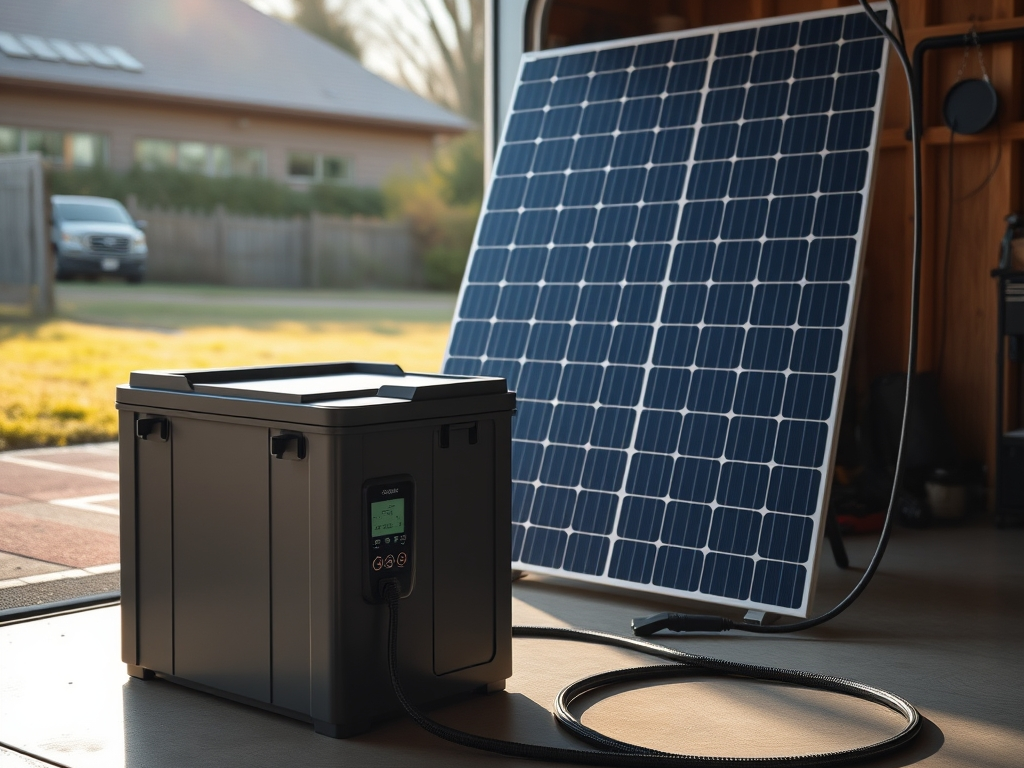
A solar generator is a self-contained unit with solar panels, a charge controller, a battery and an inverter that turns stored DC into standard AC power. [1] The battery is usually lithium-ion or lithium iron phosphate. [1] The same category covers residential backup during grid outages and camping or RV use; the hardware differs by size and output, not by principle. [1]
A unit sold without solar panels is a portable power station rather than a solar generator, and the term gets used loosely in consumer marketing. [1] If you want to recharge from the sun during a long outage, check that panels are included or supported before you commit.
For whole-home ambitions, the practical dividing line is 240V. Heavy loads like central air, well pumps and dryers call for it, and the brands state it directly: Jackery gives the Solar Generator 5000 Plus a 120V/240V rating [2]; EcoFlow says a single DELTA Pro 3 can deliver both 120V and 240V output at up to 4000W [3]; and Anker SOLIX calls the F3800 Plus a 240V plug-and-play option for powering home AC and a refrigerator [4].
Safety certification is the other thing to look for on anything you plan to leave connected indoors. EcoFlow says the DELTA Pro Ultra is certified to both UL1973 and UL9540 [3], and Anker SOLIX says the S5000 is UL9540 and UL9540A certified [4].
How to size capacity and output before you compare brands
Two numbers do most of the work. Capacity, in watt-hours or kilowatt-hours, is how much energy the battery holds, and it sets how long you can run things. Output, in watts, is how much the unit can deliver at once, and it sets what you can start and run together.
Start with a short list of what must stay on: fridge, freezer, lights, internet router, phone charging, medical equipment, maybe a fan. Note the running watts and the higher surge watts of anything with a motor or compressor. Then decide the outage length you want to cover. That combination points to a capacity class before you look at a single product page.
The ranges on the market are wide. Jackery’s lineup runs from a 288Wh unit up to a 5040Wh, 7200W system [2]. EcoFlow’s DELTA Pro Ultra is listed at 6–90kWh with 7.2–21.6kW output, and the DELTA Pro Ultra X at 12–180kWh and 12–36kW [3]. Anker SOLIX’s S5000 is a 5kWh station, and the smaller S2000 is rated for up to 35 hours of fridge backup [4].
Recharge speed matters in a multi-day outage. Jackery lists an emergency charge time of 1.7 hours for the Solar Generator 2000 v2 and a full solar charge in 3 hours for the 1000 v2 [2]. Solar input is what keeps a system going when the grid stays down longer than the battery does; EcoFlow lists up to 40kW of solar input on its OCEAN Pro [3].
Decide too between a portable station you wheel out and plug appliances into, and a system tied into your home’s wiring. Anker SOLIX’s E10 is described as switching over automatically during outages and balancing power across up to 12 circuits [4]. That is a different project from a plug-in portable, and it is worth knowing which one you are actually shopping for.
What Jackery, EcoFlow and Anker SOLIX offer
Jackery sells solar generators, portable power stations, solar panels and accessories, and groups home backup solutions into basic, standard and premium bundles built around the HomePower 3000, HomePower 3600 Plus and Explorer 5000 Plus. [2] The site includes a US region selector, and the brand advertises 30-day returns, a free warranty return and up to five years of free warranty. [2]
EcoFlow organizes its catalog around power stations, whole-home backup and home batteries, including the DELTA Pro, DELTA Pro 3, DELTA Pro Ultra and Ultra X, the TITAN series and the OCEAN series. [3] Returns are accepted within 30 days of receiving an order and the return service is currently available to US orders only; orders cannot be canceled more than 30 days after they ship, and there is no shipment to outlying areas including Puerto Rico, Hawaii and Alaska. [3][5]
Anker SOLIX offers portable power stations, solar generators, home battery systems and a home power system line, with the F3000 and F3800 Plus aimed at essential and whole-home backup and the E10 handling automatic whole-home switchover across up to 12 circuits. [4] The site says the brand is available in 146 countries; it does not confirm shipping to the US, so check availability in your region before ordering. [4]
| Brand | What they offer | Worth knowing |
|---|---|---|
| Jackery | Solar generators and portable power stations from a 288Wh LiFePO4 unit up to the 5040Wh / 7200W Solar Generator 5000 Plus with 120V/240V output, plus HomePower models sold as home backup bundles. [2] | 30-day returns, a free warranty return and up to five years of free warranty; the site has a US region selector. [2] |
| EcoFlow | Whole-home backup and home battery lines: DELTA Pro Ultra at 6–90kWh and 7.2–21.6kW, DELTA Pro 3 at 4–48kWh with 120V and 240V output, TITAN at 5–30kWh, and OCEAN Pro with 24kW output and 40kW solar input. [3] | DELTA Pro Ultra is described as certified to both UL1973 and UL9540; returns within 30 days of receipt for US orders, with no shipment to Puerto Rico, Hawaii or Alaska. [3][5] |
| Anker SOLIX | S5000 5kWh portable station certified to UL9540 and UL9540A, F3800 Plus with 240V plug-and-play output for home AC and a fridge, F3000 essential backup, and the E10 system that balances up to 12 circuits. [4] | The site states availability in 146 countries but does not confirm US shipping, so verify it ships to your address before ordering. [4] |
Which option fits whom
Renter or apartment dweller covering essentials. A portable station plus a folding panel is the realistic path, because you cannot wire anything into the building. Look at the smaller end of Jackery’s range, which starts at 288Wh and includes a 1024Wh HomePower 1000 v2 with 1800W output [2], and at Anker SOLIX’s S2000, rated for up to 35 hours of fridge backup [4]. Check availability for Anker SOLIX in your region first. [4]
Homeowner who wants central air or a well pump to keep running. You need 240V output and a capacity figure in the several-kWh range at minimum. The 120V/240V Solar Generator 5000 Plus [2], the DELTA Pro 3 with 120V and 240V outputs and up to 4000W in one unit [3], and the F3800 Plus with its 240V plug-and-play output [4] are the models each brand points at for this job.
Household planning for multi-day outages. Capacity and solar input matter more than peak output. EcoFlow’s expandable DELTA Pro Ultra range of 6–90kWh [3] and the OCEAN Pro’s 40kW solar input [3] are aimed at this, and Jackery’s premium home backup bundle pairs the Explorer 5000 Plus with two SolarSaga 340 X panels [2].
Homeowner who wants automatic switchover without a portable. A circuit-level system is the closer fit. Anker SOLIX’s E10 monitors severe weather, auto-charges from solar and grid, switches over during outages and prioritizes up to 12 circuits [4]. EcoFlow’s OCEAN Pro is quoted as an all-in-one ecosystem rather than an off-the-shelf box. [3]
Buyer who wants room to expand later. Look for an expansion path. Jackery lists a 5040Wh Solar Generator 5000 Plus [2], EcoFlow lists expandable capacity ranges across its DELTA Pro series [3], and Anker SOLIX sells its S5000 with an expansion battery option [4].
What to check before ordering
Backfeeding rules. Plug-and-play solar that feeds a regular wall outlet is illegal in many countries and areas, because backfeeding needs approval, a fixed grid connection, metering and a licensed electrician. [1] Do not assume you can wire a system into your panel yourself; confirm what your utility and local code require.
Return terms. EcoFlow’s window closes 30 days after you receive the unit, and cancellations after the first 24 hours but before delivery carry a transaction fee. [5] Jackery advertises 30-day returns. [2] Read the policy for the specific model, since bundles and accessories can differ.
Certification on anything permanently connected. UL1973 and UL9540 come up repeatedly as the marks brands cite for home use [3][4], and they are worth asking about directly if a listing does not mention them.
Whether panels are in the box. The generator-versus-power-station distinction is easy to miss in a product name [1], and a unit that arrives without panels will not recharge itself during a long outage.
Current specs and shipping. Capacity, output and warranty terms change between model revisions. Confirm the numbers and whether the brand ships to your address on its own site before you order.
A solar generator sized for essentials is a different purchase from a whole-home system, and both are different from a battery tied into your electrical panel. Pick the category first, then the model.
Sources
- Solar generator (Wikipedia) — Wikipedia
- Jackery official site — ca.jackery.com
- EcoFlow official site — ecoflow.com
- Anker SOLIX official site — ankersolix.com
- EcoFlow: Return & Refund Policy — us.ecoflow.com
How we put this together: we compared these options using each brand's published product and policy pages and the references listed above. We haven't tested the products ourselves, and details such as prices and policies can change, so check the brand's site before you buy.