
How do portable solar panels work? Sunlight hits the photovoltaic cells inside the panel and frees electrons, which flow through a circuit as direct current. [1] That current runs down the panel’s cable into a charge controller and battery — in most portable kits, a power station — and an inverter turns it into household alternating current when you plug a device in. [1] Nothing inside the panel moves, and it makes power only while light reaches it. [1][2]
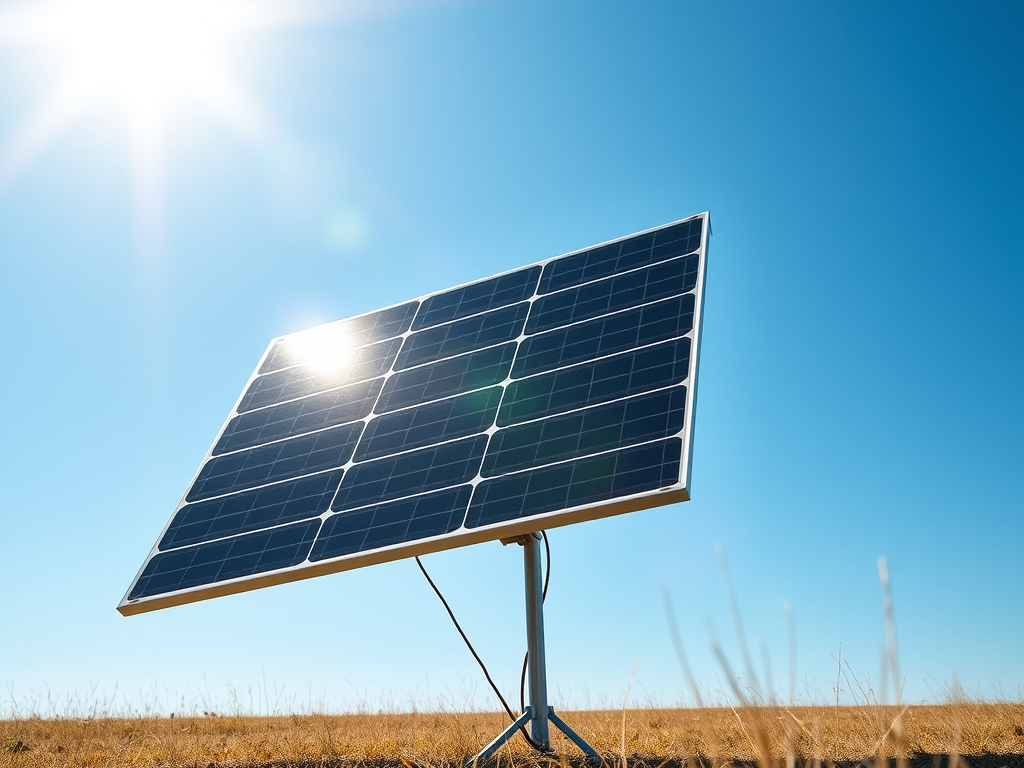
What happens inside the panel itself
A solar panel is a device that converts sunlight into electricity using multiple solar modules made of photovoltaic cells. [1] Those cells are built from materials that produce excited electrons when exposed to light, and the flow of those electrons through a circuit is direct current electricity. [1] For most modules, the cells are either crystalline silicon wafers or thin-film types. [1] Jackery says its portable solar panels are built with monocrystalline silicon solar cells. [3]
Cells are wired together into a module, and modules are grouped into a panel or an array. [1] Cell type and the area collecting light are what set how much current a panel can deliver under a given amount of sun, which is why a folding panel and a rooftop array are the same physics at very different scales.
What the rest of a portable setup does
The panel is only one part of the system. Sunlight is turned into direct current by solar cells, which can run equipment or charge batteries, and a photovoltaic system typically includes one or more panels plus an inverter to change direct current to alternating current when needed, along with optional parts like charge controllers, meters, or solar trackers. [2][1]
In a portable kit those parts are split between the panel and the power station. Jackery outlines a three-part process: put the panels in direct sun to gather solar energy, turn that energy into electricity and store it in a power station, and then use the stored power for appliances at night or in rainy weather without depending on the sun. [3] That stored-energy step is what separates a portable solar setup from a bare panel: the panel alone stops producing the moment shade or darkness arrives, while the battery keeps the outlets live.
The charge controller in that chain regulates what reaches the battery, and the inverter feeds standard AC outlets. [1] If you already own a power station with a built-in solar input, you are buying only the panel and cable side of the system.
How do foldable and plug-in portable panels differ?
There are two shapes of the same idea. Folding panels are the travel version — Jackery describes its portable solar panels as foldable with quick setup [3], and VTOMAN’s lineup includes a 400W foldable portable solar panel alongside 40W, 110W, 200W and 200W Pro panels. [4] Foldables pack down, get carried to a campsite or a sunny corner of a yard, and are repositioned by hand.
Plug-and-play portable solar is the at-home version. Brattleboro’s write-up describes portable solar, or plug-and-play solar, as small panels that can go on a deck, balcony, roof, or ground rack; systems of about 1200 watts—about three panels—might be permitted under final state rules, and renters can take the systems along when they move, with room to add capacity if a household needs more power. [5] That renter-friendly, movable quality is the main practical difference from a fixed rooftop installation, which supplies the electricity grid. [1]
How well do portable solar panels work?
Panel output tracks the sun. Solar panels need sunlight that is available and strong enough, must be cleaned, and come with high upfront costs, while photovoltaic output varies and needs balancing through storage or the grid. [1][2] In practice that means a portable panel produces best in direct, unobstructed sun at a good angle, less in haze or long shadows, and nothing after dark — which is exactly why the battery in the setup matters as much as the panel.
Brands make their own claims about cell design. Jackery says its IBC solar technology ensures continuous and stable output, which it says makes its solar chargers ideal for high temperatures or cold environments. [3] Treat that as the manufacturer’s description of its cells and check the panel’s published output ratings for the conditions you actually expect.
How does a portable solar panel charger work for small devices?
The principle does not change with size. Solar cells produce direct current from sunlight that can be used to power equipment or recharge batteries [2], so a small folding panel can top up a phone, a power bank or a jump starter without any full-size power station in the chain. Wattage is where the versions diverge in practice: VTOMAN lists a 40W portable solar panel next to its 110W, 200W, 200W Pro and 400W panels [4], and a lower-wattage panel simply has less collecting area and takes longer to deliver the same charge. Devices that accept direct current can work from the panel’s output; anything with a standard AC plug needs an inverter, which is what a power station provides. [1]
What to check before pairing a panel with a power station
- Solar input specs. Read the power station’s solar input voltage range and connector type on the brand’s site before buying a panel. VTOMAN sells a 3-meter solar cable compatible with VTOMAN solar panels [4], and Jackery lists its SolarSaga 340 X panel alongside its solar generators [6], so start with the station you own and match the panel to it.
- Panel size versus portability. VTOMAN’s range runs from 40W to a 400W foldable model [4]; a bigger panel earns more sun but is heavier to carry and takes more space to set up.
- Where it will sit. A deck, balcony, roof or ground rack changes both the angle you can achieve and how much shade you can avoid. [5]
- Buying the panel alone or in a bundle. VTOMAN sells portable solar panels on their own and also in solar generator bundles with its power stations [4], and Jackery groups its panels with its solar generators and battery packs [6].
- Policies. Jackery advertises 30-day returns and up to 5 years free warranty [3]; VTOMAN advertises free shipping to the US, Canada and Mexico [4]; EcoFlow’s US site advertises free shipping for all with no shipment to outlying areas including Puerto Rico, Hawaii and Alaska. [7]
| Brand | What they offer | Worth knowing |
|---|---|---|
| VTOMAN | Portable solar panels of 40W, 110W, 200W, 200W Pro and a 400W foldable model, sold alone or bundled with VTOMAN power stations [4] | Panels and stations come from the same brand, so match the panel to your station’s solar input; VTOMAN advertises free shipping to the US, Canada and Mexico [4] |
| Jackery | Foldable portable panels built with monocrystalline silicon solar cells and IBC solar technology, listed with its solar generators and battery packs [3][6] | Jackery says the IBC cells keep output continuous and stable in high or cold temperatures [3]; the site advertises 30-day returns and up to 5 years free warranty [3] |
| EcoFlow | A dedicated portable solar panels collection on its US site [7] | EcoFlow advertises free shipping for all, with no shipment to outlying areas including Puerto Rico, Hawaii and Alaska [7] |
Which option fits whom
Camping and weekend trips: a foldable panel you can reposition by hand is the natural pick — Jackery’s panels are described as foldable and portable [3], and VTOMAN lists a 400W foldable portable solar panel. [4]
Home outage backup with a station you already own: start from the station’s solar input and choose a matching panel; VTOMAN sells its panels both separately and in bundles with its own power stations [4], and Jackery keeps its panels and generators in the same catalog. [6]
Renters who want solar without a roof installation: the plug-and-play style described by the town of Brattleboro — panels on a deck, balcony, roof or ground rack, movable when you move, expandable later. [5]
Small devices only: a low-wattage panel such as VTOMAN’s 40W model is enough to top up batteries directly, without a full power station. [2][4]
Brand-level browsing: EcoFlow’s site has a portable solar panels collection page to compare its range [7], which is the place to confirm which models pair with which of its stations.
Whichever direction you go, confirm the current panel specs, connector type and support policies on the brand’s own site before ordering, since product lineups and program details change.
VTOMAN Jackery EcoFlow
Sources
- Solar panel (Wikipedia) — Wikipedia
- Photovoltaics (Wikipedia) — Wikipedia
- Jackery official site: Title: Foldable and Portable Solar Panels – Jackery CA — ca.jackery.com
- VTOMAN official site: Title: Solar Panels | Portable Solar Panels | VTOMAN — vtoman.com
- Title: Learn About Portable Solar — brattleboro.gov
- Jackery official site — ca.jackery.com
- EcoFlow official site: Title: Portable Solar Panels | Effortless Power for Outdoor — us.ecoflow.com
How we put this together: we compared these options using each brand's published product and policy pages and the references listed above. We haven't tested the products ourselves, and details such as prices and policies can change, so check the brand's site before you buy.