
Understanding how a solar generator works comes down to three parts: a solar panel, a battery and an inverter. The panels turn sunlight into electricity, the battery stores it, and an inverter converts that stored energy into the alternating current your appliances use. [1][2] The battery is also why the system keeps running after sunset: it holds energy captured during the day and releases it when needed. [2] Panel wattage, battery chemistry and inverter size are the details layered on top of that loop.
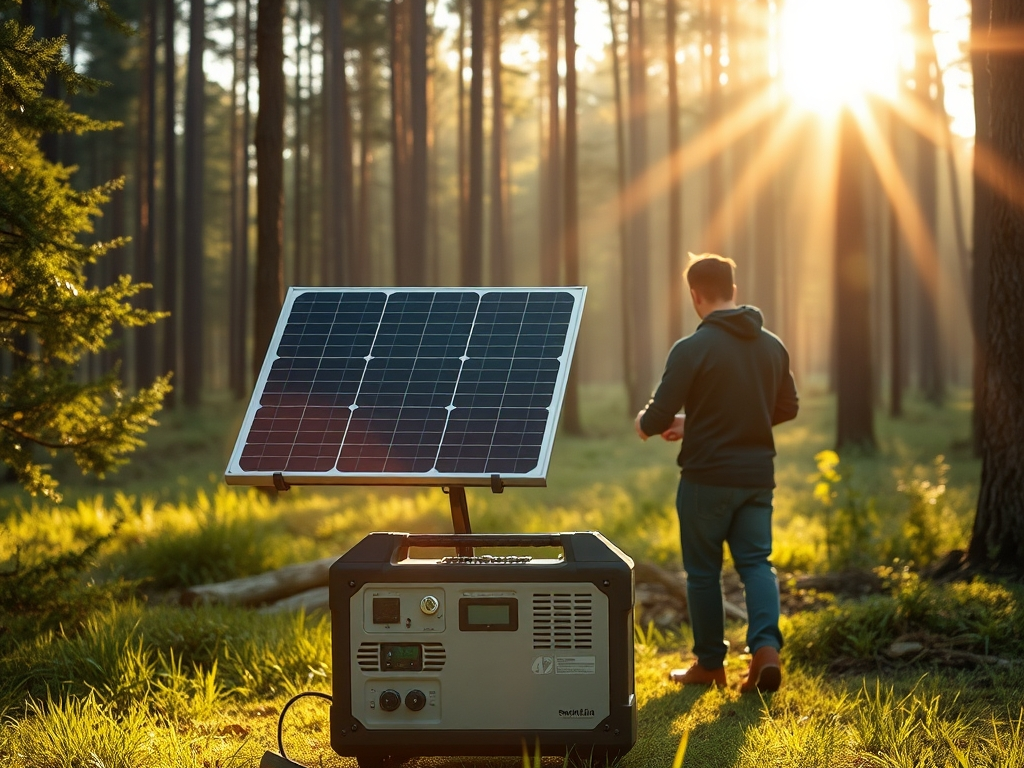
What each part of a solar generator does
A solar panel is a photovoltaic (PV) device. Sunlight hitting a solar panel is taken in by its PV cells; this produces electrical charges that shift because of the cell’s internal electric field, which makes current flow. [1] Silicon is usually the semiconductor that does this job. [1]
The electricity a panel makes is direct current, and it goes into a battery. Rechargeable batteries can be discharged and recharged many times, and lithium-ion is the chemistry used for portable electronics and electric cars. [3] In storage terms, the battery captures electricity, holds it as another form of energy, and releases it when it is needed. [2]
An inverter turns the battery’s direct current into the AC power that plugs and household appliances expect, and a charge controller manages how the panel’s output reaches the battery. Storage always involves some energy loss, both when energy is put in and when it is taken out, so it is not fully efficient. [2]
A simple way to hold it in your head: the panel is the collector, the battery is the tank, and the inverter is the translator between the tank and your devices.
How does a solar generator work at night?
At night the panels produce nothing and every watt comes out of the battery. Pairing solar with storage matters because stored power lets solar add to the electricity supply after the sun has gone down. [2]
How long it lasts is a matter of capacity versus load. Energy capacity is the total amount of energy a battery can store, usually measured in kilowatt-hours, while power capacity is the amount of energy it can release at a given moment, usually in kilowatts. [2] A big tank with a small spout runs a lamp for many hours; a small tank with a big spout runs a heater only briefly.
Solar production varies with season, time of day, clouds, dust, haze, shadows, rain, snow and dirt. [2] A cloudy winter day may therefore put less into the battery than a clear summer one, and the reserve you start the evening with depends heavily on the day before. Many systems can also be recharged from a wall outlet or a car rather than only from panels. [4]
To size a night of backup, add up the watts of what you plan to run, estimate the hours, and compare that with the battery’s kilowatt-hours. Leave headroom, because conversion losses are unavoidable. [2]
How well does a solar generator work in real conditions?
The system works well within its ratings; most disappointment comes from mixing up panel efficiency with whole-system performance. Jackery says its panels use monocrystalline silicon cells and reach an industry-leading efficiency rate of 25 percent. [4] EcoFlow says its TOPCon panels reach up to 25 percent conversion efficiency and 99 percent MPPT efficiency. [5] Those figures describe how well a panel turns sunlight into electricity, not how much of it survives the trip into and out of the battery.
Two other limits matter more day to day. Storage is never fully efficient, so some energy is lost on the way in and on the way out. [2] And output is capped by power capacity: a unit with a large battery but a modest power rating will run a fridge but not a whole counter of high-draw appliances at once. [2]
How a portable solar generator differs from a whole-home one
Jackery says a solar generator uses panels to collect sunlight and keep that energy in a portable power station, and the brand lists camping, RV trips, off-grid living and home backup as uses. [4] The U.S. Department of Energy notes that solar plus storage can serve microgrids and smaller-scale applications, including mobile or portable power units. [2]
The physics is identical; the scale is not. EcoFlow calls its DELTA Pro Ultra its most powerful whole-home backup solution, with 6144Wh of capacity expandable to 30kWh and 7200W of output. [5] Jackery lists a Solar Generator 5000 Plus at 5040Wh and 7200W with 120V/240V output. [4] Anker SOLIX presents the S5000 as a 5kWh portable power station. [6] Portable kits trade capacity for the ability to fold up and move; home units trade portability for size, outlets and wiring options.
What actually differs between brands
Jackery frames its line around portable power stations paired with SolarSaga panels, emphasizing quick solar recharging, high solar conversion and three ways to recharge. [4] Its listed models run from the Solar Generator 300 Plus at 288Wh with a LiFePO4 battery up to the Solar Generator 5000 Plus at 5040Wh and 7200W. [4] The site lists 30-day returns and up to five years of free warranty. [4]
EcoFlow builds its pitch around X-Boost technology, which it says surges to 6000W to support high-voltage appliances, LFP batteries with an IP65-rated battery, and a battery management system powered by X-Guard that monitors 40 safety indicators around the clock. [5] EcoFlow backs its solar generators with a five-year warranty. [5] Returns are available on US orders within 30 days of receipt, and orders cannot be canceled more than 30 days after they ship. [7]
Anker SOLIX presents the S5000 as a 5kWh portable power station and the S2000 as a 2kWh unit with up to 35 hours of fridge backup. [6] The company says its products are available in 146 countries; check whether it ships to the US before ordering. [6]
| Brand | What they offer | Worth knowing |
|---|---|---|
| Jackery | Solar generators pairing portable power stations with SolarSaga panels, from the 288Wh Solar Generator 300 Plus to the 5040Wh / 7200W Solar Generator 5000 Plus with 120V/240V output [4] | Panels use monocrystalline cells rated at 25 percent efficiency; the site lists 30-day returns and up to five years of free warranty [4] |
| EcoFlow | DELTA and RIVER solar generator bundles, including the DELTA Pro Ultra at 6144Wh expandable to 30kWh with 7200W output [5] | LFP batteries with an IP65-rated battery and X-Guard monitoring of 40 safety indicators; five-year warranty; US returns within 30 days of receipt [5][7] |
| Anker SOLIX | S5000 5kWh portable power station and S2000 2kWh unit with up to 35 hours of fridge backup [6] | The company says it is available in 146 countries; confirm shipping to the US before you order [6] |
Which option fits whom
If outages are the main reason you are looking, capacity and power rating matter more than panel efficiency. An expandable whole-home unit such as EcoFlow’s DELTA Pro Ultra, at 6144Wh expandable to 30kWh and 7200W output, is built for running household circuits rather than a single appliance. [5]
If you want one box that covers camping, RV trips and short home outages, the mid-size portable class is the practical zone. Jackery’s Solar Generator 1000 v2 carries 1070Wh and the brand says it fully solar-charges in three hours. [4] Anker SOLIX’s S2000 is a 2kWh unit the company ties to up to 35 hours of fridge backup. [6]
If night runtime with heavy loads is the priority, compare watt-hours first and watts second. Jackery’s Solar Generator 5000 Plus puts 5040Wh behind 7200W of output [4], while EcoFlow’s DELTA 3 Ultra Plus carries 3072Wh expandable to 11kWh with 3600W of output. [5] The first number tells you how long, the second tells you what can run at once. [2]
If you are still deciding whether solar charging is worth it at all, remember that every one of these systems can also recharge from a wall outlet, and that many buyers use the panels as a top-up rather than the only source. [4] Panel output will drop in clouds, rain, snow or shade regardless of brand. [2]
Whichever brand you look at, confirm the current capacity, output and panel pairing on the brand’s own site before ordering, since model lines and specifications change.
Sources
- Title: How Does Solar Energy Work? — energy.gov
- Title: Solar Integration: Solar Energy and Storage Basics — energy.gov
- Electric battery (Wikipedia) — Wikipedia
- Jackery official site: Title: Solar Generators – Jackery CA — ca.jackery.com
- EcoFlow official site: Title: EcoFlow Solar Generators | Best Power Anywhere | EcoF — us.ecoflow.com
- Anker SOLIX official site — ankersolix.com
- EcoFlow: Return & Refund Policy — us.ecoflow.com
How we put this together: we compared these options using each brand's published product and policy pages and the references listed above. We haven't tested the products ourselves, and details such as prices and policies can change, so check the brand's site before you buy.