
How does a home battery backup work? It stores electricity in lithium-ion cells, uses software to manage charging and discharging, and converts that stored DC power back into household AC through an inverter when the grid fails. [1][2] The energy usually arrives from rooftop solar or from the grid during cheaper hours, and the system holds it until an outage or a stretch of expensive peak demand. [1][3] Capacity, output and which circuits stay live are the three variables that separate one system from another.
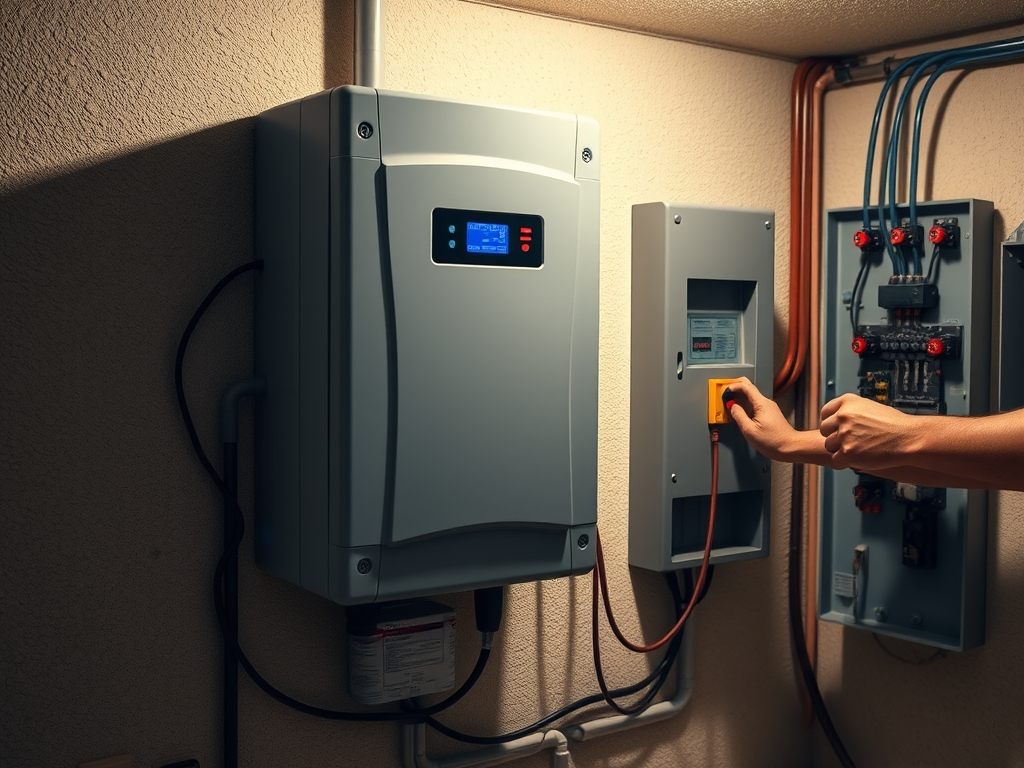
What the parts inside the system actually do
A cell is the fundamental building block of a battery energy storage system and holds the chemicals that store electrical energy; a typical lithium-ion cell is a bit bigger than an AA battery, and larger systems are made up of many cells. [4] On top of the cells sits a battery management system, and the pack is run by intelligent software that handles the charging and discharging cycles. [1][4] The Rhode Island Office of Energy Resources describes a battery system as shorthand for a battery energy storage system, a term typically used for residential and commercial cases. [4]
The inverter is what makes the stored energy usable in a house wired for alternating current. In an online uninterruptible power supply, incoming AC is rectified to DC to pass through the battery, then inverted back to 120V/230V AC for the protected equipment. [2] A transfer mechanism then separates your home from the utility line. In a standby (off-line) design, the switch-over from utility power to the inverter can take as long as 25 milliseconds, depending on how quickly the unit detects the lost voltage. [2]
Chemistry matters for longevity and disposal. Lithium-ion is the common choice for home storage because of its relatively high charge cycle life and lack of memory effect, though the batteries are difficult to recycle; lead-acid is easier to recycle. [1] Smaller flow battery technology is also being developed for home use. [1]
What happens when the grid fails
A home battery can act as backup power during an outage, keeping essential lighting, heating, computing and home medical equipment running without disruption. [1] How much of the house stays on depends on how the system is wired. A whole-home setup feeds a panel that carries the circuits you have assigned to it, while a smaller setup may cover only a subpanel of chosen loads.
Circuit-level control is where the products differ most. EcoFlow’s Smart Home Panel 3 is listed as handling 32 circuits, and the DELTA 3 Ultra Plus lets an owner pick which circuits stay powered through the app so the stored energy goes to what matters most. [5][6] Anker SOLIX lists its E10 systems with 120V/240V support so refrigerators, lights, routers, pumps and larger appliances can keep running, and quotes 10–30 kW Turbo Output described as enough for 5-ton central A/C startup. [7]
It helps to know what a home battery is not. A conventional uninterruptible power supply provides near-instantaneous protection from short interruptions, but its on-battery runtime typically runs from 5 to 15 minutes — enough to start a standby source or shut equipment down cleanly. [2] A home battery sized for an outage is doing a different job over a much longer window.
Where the stored electricity comes from
Most commonly it comes from rooftop solar. Panels generate direct current during daylight, and that electricity can either be fed back to the grid through a solar inverter or stored in the battery for use after sundown. [1] That lets a household use its own midday generation in the evening instead of buying power at peak prices. [1] Small wind turbines are less common but available as a complement or alternative to solar. [1]
The second source is the grid itself, and whether that saves you anything depends on your rate. Under a time-of-use structure, utilities charge more during high demand and less when demand falls, with peak usage generally in the evenings and mid-day and overnight hours sitting at mid- or off-peak. [3] Pacific Northwest National Laboratory notes that off-peak rates are always lower than the utility’s flat rate while on-peak rates are higher, which it calls a large opportunity for solar and storage. [3] If your utility charges a flat rate, a battery may make less financial sense unless you live somewhere with grid reliability problems or exposure to extreme weather. [3]
Net metering is the other policy to check. Where it applies, the utility purchases excess energy from rooftop solar and, in some states, from a battery as well; Arizona, California, Colorado, Hawaii, Massachusetts and New York extend net metering to battery systems, though the practice is not yet common across the country. [3] These policies change, so confirm your state’s current rules before designing a system. [3]
How does a home power bank compare with an installed battery
The line between the two is blurrier than it used to be. EcoFlow says its DELTA Pro Ultra Series power systems are modular, pairing battery, solar input and a smart home panel, and that they can start with the essentials and expand in power or days of backup as a home needs more, and can move with the homeowner. [5] The range within that family is wide: a DELTA 3 Classic is listed at 1 kWh capacity and 1800W output, while a DELTA Pro Ultra X is listed at 12–180 kWh and 12–36 kW. [6]
A portable unit is the right shape for a renter, a small apartment or a household that wants to carry power to a garage or a job site. An installed system with a transfer panel is the right shape when the goal is central air conditioning, a well pump or a multi-day outage. The practical test is the same either way: compare the capacity in kilowatt-hours against the loads you want to run, and the output in kilowatts against the surge those loads draw at startup.
Home battery options side by side
| Brand | What they offer | Worth knowing |
|---|---|---|
| EcoFlow | Modular whole-home backup built from battery, solar input and a smart home panel; the DELTA Pro Ultra line is listed at 6–90 kWh with 7.2–21.6 kW output, and the DELTA Pro Ultra X at 12–180 kWh with 12–36 kW. [5][6] | The DELTA Pro Ultra is listed as certified to both UL1973 and UL9540, and the Smart Home Panel 3 covers 32 circuits. [5][6] Returns are currently accepted on US orders within 30 days of receipt. [8] Shipping excludes outlying areas including Puerto Rico, Hawaii and Alaska. [5] |
| Anker SOLIX | E10 home battery systems with expandable capacity, solar input and generator support, listed with 120V/240V output and 10–30 kW Turbo Output intended to start a 5-ton central A/C. [7] | The E10 whole-home backup configuration is listed as UL9540 and 9540A certified, and bundles pair it with a Power Dock, a Smart Inlet Box or a tri-fuel Smart Generator 5500. [7] Availability in your region needs checking before you order. |
Which option fits whom
Storm-belt homeowners who want the whole house covered. Look at systems that combine a high continuous output with stackable batteries and a circuit-level panel, since running central air and a well pump is an output problem before it is a capacity problem. Both brands publish output figures in the tens of kilowatts for their larger configurations. [5][7]
Solar owners on a time-of-use rate. Storage that shifts midday solar into the evening is the classic use case, and the value comes from the rate spread rather than the hardware alone. [3] Check whether your utility offers time-of-use pricing and whether your state’s net metering rules reach batteries. [3]
Renters and movers. A modular system that can be taken to the next home makes more sense than a permanently wired panel, which is the pitch EcoFlow makes for its DELTA Pro Ultra series. [5] Confirm what the installation requires before committing to either.
Households on a flat rate with reliable power. A battery is primarily an insurance purchase in that situation rather than a savings one, since there is no price differential to arbitrage. [3] A small portable unit for phones, a router and a fridge may be enough.
Anyone buying an installed system. Ask for the certification listing (UL9540 and UL1973 appear on EcoFlow’s materials, UL9540 and 9540A on Anker SOLIX’s E10 listings) and confirm the return window in writing — EcoFlow’s US policy runs 30 days from receipt. [6][8][7] Then verify current capacity, output and eligibility details on the brand’s own site, since product lines and specifications change.
Sources
- Home energy storage (Wikipedia) — Wikipedia
- Uninterruptible power supply (Wikipedia) — Wikipedia
- Title: A Consumer’s Guide to Rooftop Solar and Home Energy Storage — pnnl.gov
- Title: Learn About Battery Storage | Rhode Island Office of Energy Resources — energy.ri.gov
- EcoFlow official site: Title: Whole-Home Backup Power Solutions | EcoFlow Home Batt — us.ecoflow.com
- EcoFlow official site — ecoflow.com
- Anker SOLIX official site — ankersolix.com
- EcoFlow: Return & Refund Policy — us.ecoflow.com
How we put this together: we compared these options using each brand's published product and policy pages and the references listed above. We haven't tested the products ourselves, and details such as prices and policies can change, so check the brand's site before you buy.