
Is whole house battery backup worth it? For most homeowners the honest answer is: it depends on three things — how often the grid actually fails you, how much your utility charges at peak hours, and whether you have solar to fill the battery. A battery earns its keep through avoided outages and time-shifted cheap power. If neither applies to your house, a smaller setup is usually the better buy.
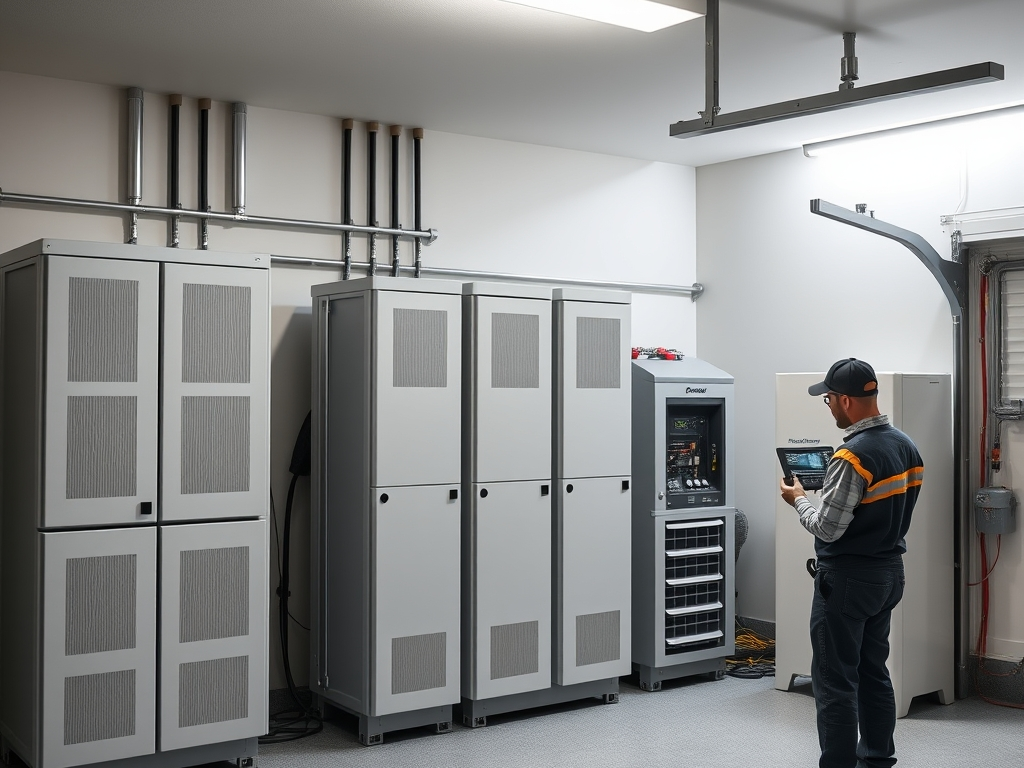
What a whole-house battery actually does
Home energy storage stores electrical energy locally for later consumption, usually in lithium-ion batteries run by software that manages the charging and discharging cycles. [1] The stored energy commonly starts as rooftop solar production during daylight hours, which can either be exported to the grid or held in the battery for use after sundown. [1] That is what makes the peak-hour math work: the battery takes advantage of the peak solar generation during the day and offsets higher-cost consumption during the domestic peak demand hours, usually mid-afternoon to mid-evening. [1]
Backup is the other half of the job. Home storage can serve as a backup battery during a power outage, keeping essential lighting, heating, computing and home medical equipment running. [1] Paired with on-site generation such as solar, storage can virtually eliminate blackouts in an off-the-grid setup. [1]
For sizing context, the second-generation Tesla Powerwall is rated at 13.5 kWh of capacity, with 5 kW continuous output and up to 7 kW in short bursts, and it was paired with a Backup Gateway that acts as a transfer switch and load center. [2] Tesla says a million Powerwalls had been installed as of 2025. [2]
The deciding factors, in order of weight
1. How often the power actually goes out, and for how long. A battery is a resilience purchase first. If you lose power a few times a season for a few hours, you are buying comfort and refrigeration, not survival — and a smaller, circuit-level setup can cover that.
2. Your rate structure. Storage pays back fastest when the gap between cheap and expensive hours is wide. The units can be programmed to exploit a differential tariff that gives lower-priced energy during hours of low demand, for consumption when prices are higher. [1] Smart tariffs from smart meters are increasingly paired with home storage for exactly this. [1]
3. Whether you have solar, or plan to. Without on-site generation, the battery can still shift cheap grid power, but it cannot refill during a long outage. Home storage is most useful when paired with on-site generation. [1]
4. Essential loads versus the whole panel. Whole-home backup needs enough output to start big loads. Anker SOLIX says its systems deliver 10–30 kW turbo output, enough for demanding home loads including 5-ton central A/C startup, with 120V/240V support. [3] EcoFlow’s Smart Home Panel 3 covers 32 circuits. [4] A essentials-only panel is cheaper to install and covers most real outages.
5. Battery chemistry and end of life. Lithium-ion is the popular choice because of its relatively high charge cycle count and lack of memory effect, but it is difficult to recycle; lead-acid is relatively easier to recycle. [1]
When it is probably not worth it
Skip the whole-house system if your outages are rare and short, your utility charges a flat rate with no meaningful peak premium, and you have no solar. The economics of storage lean on either outage frequency or a tariff spread, and with neither you are paying for capacity that sits idle most of the year. [1] The same logic applies if you only need to keep a router, a fridge and some lights alive — that is a portable power station job, not a panel-mounted battery.
One caveat worth naming up front: the home storage market drew scrutiny over initial high costs before revenue grew alongside a trend of lowering prices. [1] Costs move, so price out the whole installed job rather than the box on the website.
Comparing the systems on the market
| Brand | What they offer | Worth knowing |
|---|---|---|
| EcoFlow | Whole-home backup built around the DELTA Pro Ultra series, listed at 6–90 kWh capacity and 7.2–21.6 kW output, plus the OCEAN on-grid ecosystem that combines solar, storage, smart distribution, EV charging and app control [4] | EcoFlow says the DELTA Pro Ultra is certified to both UL1973 and UL9540, and the line pairs with Smart Home Panel 2 or the 32-circuit Smart Home Panel 3 for automatic switchover [4][5] |
| Anker SOLIX | E10 home battery systems sold in module-and-battery combinations, with 6–10 kWh capacity and 7,680W output in the listed configurations, plus generator and smart inlet box options [3] | Anker SOLIX lists the E10 whole-home backup as UL9540 and 9540A certified and says its systems support solar input, generator support and app-based power monitoring [3] |
| LiTime | LiFePO4 batteries for home storage in 12V, 24V, 36V and 48V formats, including self-heating, low-temperature and Bluetooth models [6][7] | These are components rather than a packaged whole-home system, so an installer designs the bank, inverter and switching around them [6] |
EcoFlow organizes its offerings into off-grid and on-grid backup; the brand says the DELTA Pro Ultra line is modular and can begin with basic components and expand in capacity or backup duration, while its OCEAN ecosystem brings together solar, storage, smart distribution, EV charging, and the EcoFlow App in a single system. [4] EcoFlow says the DELTA Pro Ultra is the only portable power station certified to both UL1973 and UL9540. [5] On the service side, EcoFlow accepts returns of US orders within 30 days of receipt in original packaging, and cancellations within 24 hours of placing an order. [8]
Anker SOLIX frames its home battery systems around storing solar energy, backing up essential appliances, starting central A/C, and monitoring power through the app, with expandable capacity for storms, outages and peak hours. [3] The E10 is listed in several configurations — with a Power Dock for automatic backup, or with a Smart Inlet Box for manual backup — and bundles with a tri-fuel Smart Generator 5500 are also shown. [3] Check whether the brand sells and ships to your region before you plan around it.
LiTime sells batteries rather than a finished home system, with a home battery storage section covering 12V through 48V LiFePO4 packs and options such as self-heating, low-temperature and Bluetooth models. [6][7] That makes it a fit for someone building or extending a battery bank with an installer, not for someone who wants a single box that switches the panel over automatically. Confirm shipping and support for your location before ordering.
Which option fits whom
You want a whole-home system with automatic switchover and room to grow: EcoFlow’s DELTA Pro Ultra and OCEAN lines are the most explicitly expandable here, with capacity ranges up to 90 kWh on the DELTA Pro Ultra and circuit-level panels. [4][5]
You want a modular system with generator support and central A/C startup in mind: Anker SOLIX pitches its E10 line at exactly that, with turbo output figures and tri-fuel generator bundles listed. [3] Verify regional availability first.
You are building or extending a battery bank with an installer: LiTime’s 12V–48V LiFePO4 range is component-level, so the design and switching are yours to specify. [6][7]
You only need a few circuits: You do not need a whole-house battery at all. A smaller portable station plus a transfer setup covers fridge, lights and router for far less, and you can add panel-mounted storage later.
What to check before you commit
Ask for the certification listing, not just the marketing line — UL9540 is the safety standard the packaged home systems advertise. [4][5][3] Confirm how the system switches over, since automatic transfer needs a panel or gateway, while manual setups rely on an inlet box. [4][3] Ask your installer about permits and whether your utility has a storage or interconnection program. And read the return terms before delivery: EcoFlow’s US return window is 30 days from receipt, with transaction and shipping costs deducted except on quality issues. [8]
Finally, revisit your own numbers a year after install — actual outage hours and actual peak-hour savings are the only honest measure of whether the investment paid off. Confirm current models, certifications and policies on each brand’s site before ordering, since product lines and terms change.
Sources
- Home energy storage (Wikipedia) — Wikipedia
- Tesla Powerwall (Wikipedia) — Wikipedia
- Anker SOLIX official site — ankersolix.com
- EcoFlow official site: Title: Whole-Home Backup Power Solutions | EcoFlow Home Batt — us.ecoflow.com
- EcoFlow official site — ecoflow.com
- LiTime official site: Title: Home Battery Storage | Reliable Energy Storage Soluti — ca.litime.com
- LiTime official site — ca.litime.com
- EcoFlow: Return & Refund Policy — us.ecoflow.com
How we put this together: we compared these options using each brand's published product and policy pages and the references listed above. We haven't tested the products ourselves, and details such as prices and policies can change, so check the brand's site before you buy.